"WARNING - POTENTIAL SHOCK HAZARD - ELECTRICAL CURRENTS MAY BE IN THE WATER."
That's the exact wording the National Electrical Code requires on signs at marinas and docking facilities. It was on a slide shown to Lake Glenville property owners at Slopeside Tavern on September 12, during the Friends of Lake Glenville 2026 Season Closer. Two months later the lake is dropping toward its winter level. Every year that drop opens the same window for repairs, and this year the group that watches over the lake has added the wiring to the list.
The Lake Comes Down on a Schedule Written in 2003
Lake Glenville's water level isn't Duke Energy's call from week to week. During relicensing of the West Fork of the Tuckasegee River project, stakeholders agreed on a month-by-month operating range. Friends of Lake Glenville explains that the range went into the settlement agreement and the license application and became a requirement of the license. The settlement document on Duke's site sets full pond at 100.0 feet relative, which is about 3,491.7 feet above sea level. Each target applies on the first day of the month, and the levels on days in between are interpolated in a straight line.
The part of the year that matters right now looks like this:
| First of the month | Normal minimum | Target | Normal maximum |
|---|---|---|---|
| October | 90 ft | 93 ft | 94 ft |
| November | 86 ft | 90 ft | 94 ft |
| December | 85 ft | 90 ft | 94 ft |
| January and February | 85 ft | 90 ft | 94 ft |
| March | 88 ft | 91 ft | 94 ft |
| May through July | 95 ft | 97 ft | 99 ft |
So the winter target sits 7 feet below the summer target and 10 feet below full pond. The allowed range also reaches down to 85 feet in December, January and February.
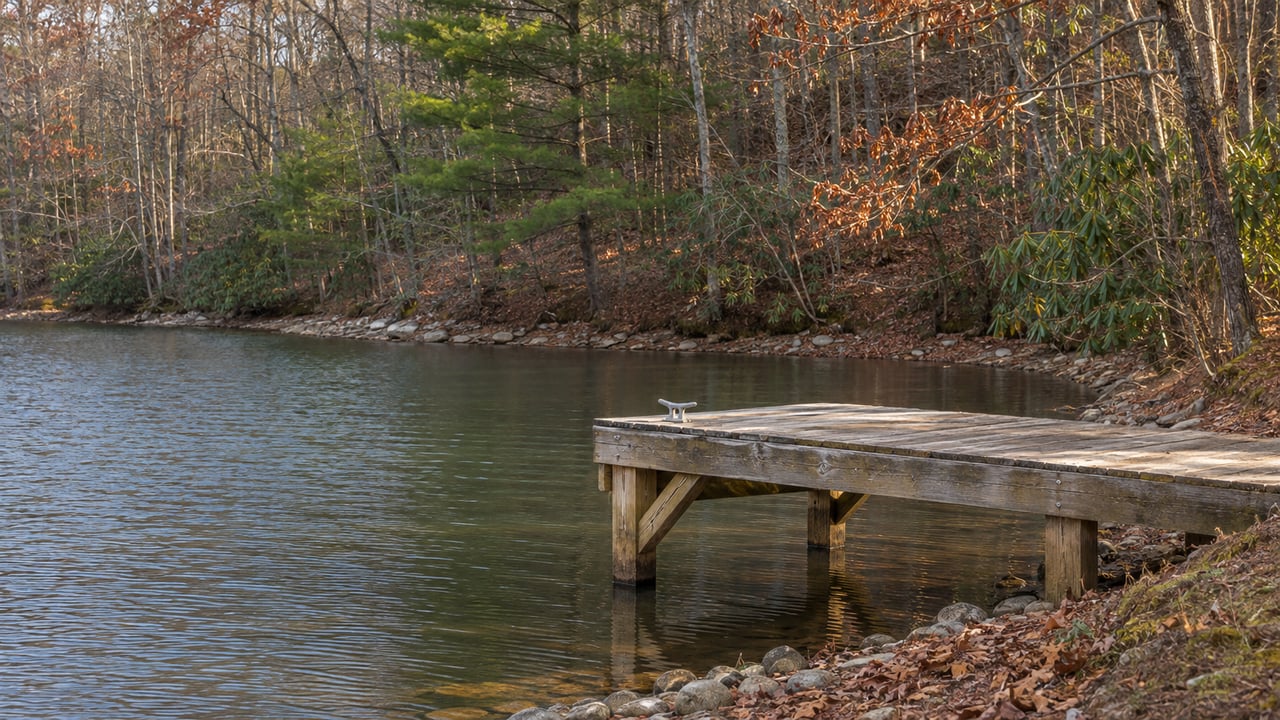
Friends of Lake Glenville gives two reasons for the drop. The first is flood storage. Targets start falling in July ahead of hurricane season, so the lake has room to take in runoff of the kind Fran and Ivan brought in 2004 and Helene brought in 2024. The second is maintenance. The group says lower fall and winter levels give homeowners a chance to work on docks and shorelines.
At midnight on November 9, Lake Glenville read 91.61 feet, about a foot and a half above the November target. Duke's own lake-level table showed 91.6 as of October 28.
A Dry Year, and No Extra Drawdown
The water was already low before the seasonal drop began. On July 16, 2026, Duke Energy put the East and West Forks of the Tuckasegee into Stage 1 of its Low Inflow Protocol. Duke cited below-normal rain, very low streamflows and falling levels at Bear Creek and Tanasee Creek reservoirs. Stage 1 cut every mainstem recreation release by half an hour and cut the West Fork recreation bypass releases by an hour, to a 10 a.m. to 3 p.m. window. Stage 1 is the first of six stages in the protocol.
Things got worse from there. According to the Season Closer slides, Stage 2 began on July 26, and by the September 12 meeting the basin had reached Stage 3, with a 35% cut in outflow and a 50% cut in recreational releases. Fall didn't make up the difference. As of November 3, the North Carolina Drought Management Advisory Council listed Jackson County in D1, Moderate Drought. Its November 5 drought explainer reported that Highlands had received 0.32 inches of rain since October 13, which is 2.25 inches below normal for the fall.
The same slides answer a question many owners had going into fall. Glenville's dam was inspected September 8 and 9, the Federal Energy Regulatory Commission signed off on September 11, and the slide says no drawdown was required. This winter follows the normal 2003 schedule, with no special lowering for dam work, and owners can plan dock work around it.
What the Permit Covers When the Water Is Down
The repair window comes with paperwork. Friends of Lake Glenville states it directly: dock and shoreline maintenance can't be done without first applying to Duke Energy Lake Services for a permit. On its shoreline permits page, Duke lists building a dock, maintaining it, modifying it and stabilizing the shoreline as activities that need a permit when they happen on Duke lake property or inside the FERC project boundary. Applications go through Duke's online Lake Access Permit System. Contractors who launch materials or equipment from a Duke access area need a separate Access Area Use permit from Duke Energy Public Recreation. Lake Glenville falls under Duke's Nantahala Area plan, along with Bear Creek, Cedar Cliff, Nantahala and Wolf Creek.
Duke's Nantahala shoreline management guidelines add a few points that bear directly on winter projects:
- New or rebuilt dock access steps need Duke's approval first.
- Erosion-control work such as riprap or dry-stacked boulder walls needs approval.
- The owner of a permitted facility is responsible for keeping it in good repair, and that responsibility passes to the next owner of the adjoining property.
Duke's permit FAQ says permits are valid for one year and that permit transfers must be submitted and inspected. Friends of Lake Glenville's list for 2026–27 also notes that the Shoreline Management Plan renews in 2028.
Why the Wiring Made the List
The September program was mostly about electricity. After welcoming remarks from David Feist, the group's president for 2026 to 2029, and a water quality update, Charlie Brunt gave a presentation on electric shock drowning.
His slides gave three figures behind the hazard:
- The threshold is small. About 10 milliamps of AC current is enough to cause loss of muscle control. A 60-watt bulb draws roughly 500 milliamps.
- Fresh water makes it worse. Lake water conducts poorly, so a swimmer's body carries the current more easily than the water around it does. A gradient of two volts AC per foot can push about 12 milliamps through a person.
- It takes two failures. A hazard requires an electrical fault, such as a short circuit, plus a missing or failed AC safety ground. That applies to docks, boats, irrigation pumps, fountains and anywhere else AC power meets fresh water.
The presentation included case files from Cherokee Lake in Tennessee and Lake Lanier in Georgia, plus a July 2026 incident on Lake Vermilion in Minnesota. It also walked through the National Electrical Code's dock provisions. The presentation slides say North Carolina has adopted the code into law. The Article 555 items on the slides include warning signage, bonding of metal parts that don't carry current, ground-fault protection rated at no more than 100 milliamps on dock feeders and no more than 30 milliamps on receptacles, and an emergency disconnect that is clearly marked and easy to reach. The slide notes that a circuit breaker handle doesn't count as that disconnect.
The Price List From the Slides
The slides also put rough numbers on the work, covering materials and labor:
| Item | Cost estimate | Time estimate |
|---|---|---|
| Dock electrical review and evaluation | Electrician's hourly fee | About 1 hour |
| 100 mA GFCI breaker on the feeder | $400–$800 | 1–2 hours |
| 30 mA GFCI breaker on the dock subpanel | $100–$250 | 1–2 hours |
| Wet-location conduit or cable upgrade | About $1,500 per 100 feet | About a full day, depending on terrain, access and distance |
| Grounding electrode system at dock subpanel | About $300 | 1–2 hours |
| Wet-location receptacles and in-use covers | About $50 per outlet | |
| Permit, inspection, miscellaneous | $200–$600 |
For a dock with a short cable run, adding up the breakers, grounding and permit lines gives a total in the low thousands. The conduit line is the one that grows with distance, and it's also the one that depends on terrain and access. With the lake 10 feet down, more of that terrain is dry and easier to work on.
The closing slides suggested talking with nearby owners about switching off dock power when it isn't in use and agreeing on a timeframe to bring dock wiring up to the current code. Emergency shut-off stickers and warning signs were free at the meeting.
The Lake Around the Work This Winter
Signal Ridge Marina has finished its season, which runs from the first Monday in April through the last day of September. That puts its 2027 opening on Monday, April 5. The lake's two public ramps, at the Powerhouse and Pine Creek access areas, are both at the north end of the lake. Any contractor using either one to bring in materials needs the Access Area Use permit mentioned above.
On the shore, Pines Recreation Area is listed as open year-round, with a beach, pier, picnic tables and vault toilets. The High Falls trailhead is across the road. The lake should stay near 90 feet through February. The targets start back up in March, reach 93 feet on April 1 and 97 feet in May, so the dry ground under a dock goes back underwater on that schedule.
This post is general information about Duke Energy's rules and the Friends of Lake Glenville presentation. It isn't legal or electrical advice. Please confirm your own dock's permit status with Duke Energy Lake Services and have its wiring looked at by a licensed electrician.
If a dock permit transfer or an electrical upgrade is part of your plan to sell a Lake Glenville home, Great Smoky Mountain Homes can help you think through how that work fits into your timeline and your price. Request your free home valuation, and we'll start with your stretch of shoreline.